





2020: A year like no other, and catastrophic for the airline business. The Covid-19 pandemic has created a spiral of economic misery.
With national borders closed and airline fleets grounded, there have been mass job cuts. It is estimated that Tourism accounts for 10% of the global GDP, and this year The UN World Tourism Organization is predicting a fall in international travel spending of close to US$1 trillion: some 330 million jobs are directly affected. According to The International Air Transport Association (IATA), the travel business might not return to 2019 levels until 2023-2024.
I am sure the majority of the 4.54 billion passengers who flew on the world�s scheduled airlines during 2019, are greatly longing to take to the skies again -- as am I. In the meantime, I hope that Readers will enjoy seeing the pictures and descriptions of the hundreds of aircraft-cabin scenarios that are featured in my E-BOOK APP JETLINER CABINS: Evolution & Innovation. (Click here to read the REVIEWS.)
Flying has become such a natural part of our modern lives and many of us hop on and off airplanes without giving a second thought. But let me assure you that hours and hours of thinking have gone into making the experience a pleasant one for those who fly. I know because I was often leading programmes involving teams of hundreds of people coming up with ways to keep passengers comfortable and safe on their journeys. This book is the first to reveal the hidden secrets of interior jetliner-cabin design: it charts key innovations and challenges -- including current, all-important health and hygiene developments to combat coronavirus -- and looks back at legendary airline brands, over the past 50 years.
I find it incredible that, since its launch in 2003, JETLINER CABINS is still classed as the first and only comprehensive survey of commercial aircraft design from the 1970s to the present day. Being the first in its field, I am delighted that my book has become the go-to reference for aviation professionals and enthusiasts alike, and I hope you will enjoy reading it.
Jennifer Coutts Clay
New York
www.jetlinercabins.com

The ONLY Book on Evolving Jetliner Interiors -
Now Available as an APP!
UPDATED FEBRUARY 2021

Newly Revised and Updated Edition of First and Only Book to Offer a Comprehensive Survey of Jetliner Interiors Available as an APP
Prepare for take-off with this fascinating and pioneering interactive E-BOOK APP about Jetliner Cabins. Airline interiors, like everything else, have changed over the years. All those who have noticed the metamorphosis plus anyone who is interested in the history, evolution, and development of aircraft cabin interiors will enjoy JETLINER CABINS: Evolution & Innovation by longtime airline consultant Jennifer Coutts Clay. (Click here to read the REVIEWS.)
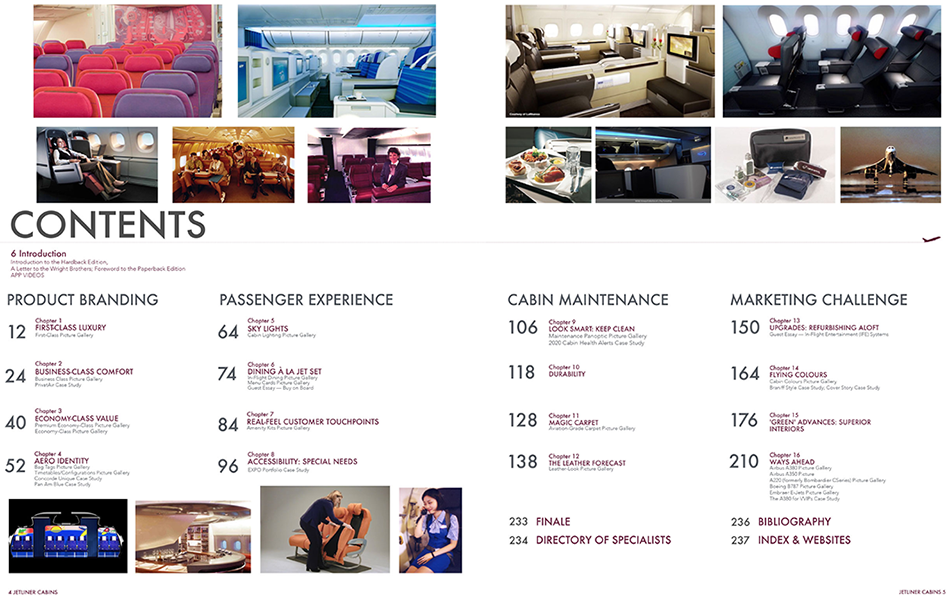
In this App, you will find everything you ever wanted to know about what goes into creating your aircraft cabin experience when you fly. How do they decide the shape and style of the seat, legroom, cushioning, drop-down table, and look and feel of the whole interior while keeping in mind passenger health and safety and the demands of the flying environment? There are many challenges faced in the layout of such a tight space, and the solutions and design ideas will surprise you at every turn.
JETLINER CABINS: Evolution & Innovation is a visually stunning treat that offers a complete history of recent cabin design going back to the 1970's. It is the first and only comprehensive account of the aircraft-cabin environment. The book contains black and white and color photographs of airline interiors from around the world, covering everything from first-class luxury to economy-class passenger experience. Coutts Clay explains all the challenges faced and met by brilliant, interior jetliner-cabin designers from dining, cleaning, safety and durability to sustainability, accessibility, air quality, inflight entertainment, branding etc.
Additionally, the E-BOOK APP is regularly updated to reflect industry innovations. If you want to know what the airline industry is doing to respond to the Covid-19 pandemic, for example, the answers are here. Since the first publication in 2003, JETLINER CABINS: Evolution & innovation has become the go-to reference for aviation professionals and enthusiasts, and is available on Amazon, Apple App, and Google Play. Using Click points and the Search facility throughout, readers can navigate the content according to their personal interests. There are more than four hundred organizations referenced in the text and links to their websites, along with six thousand pictures, many of them vintage. The App also includes bonus material such as Case Studies, Guest Essays, and Comments from over fifty international specialists.
If you're a passenger, an interior designer, architect, or airline enthusiast, JETLINER CABINS: Evolution & Innovation promises and delivers a truly memorable journey.
"The only comprehensive survey of the aircraft cabin environment from the 1970s to the present day�An ideal source for those wanting to learn or simply reminisce about the evolution of airline cabins and in-flight service."" - Airliner World magazine


